Workplace Security Assessments: How to Identify and Prioritize Physical Security Vulnerabilities
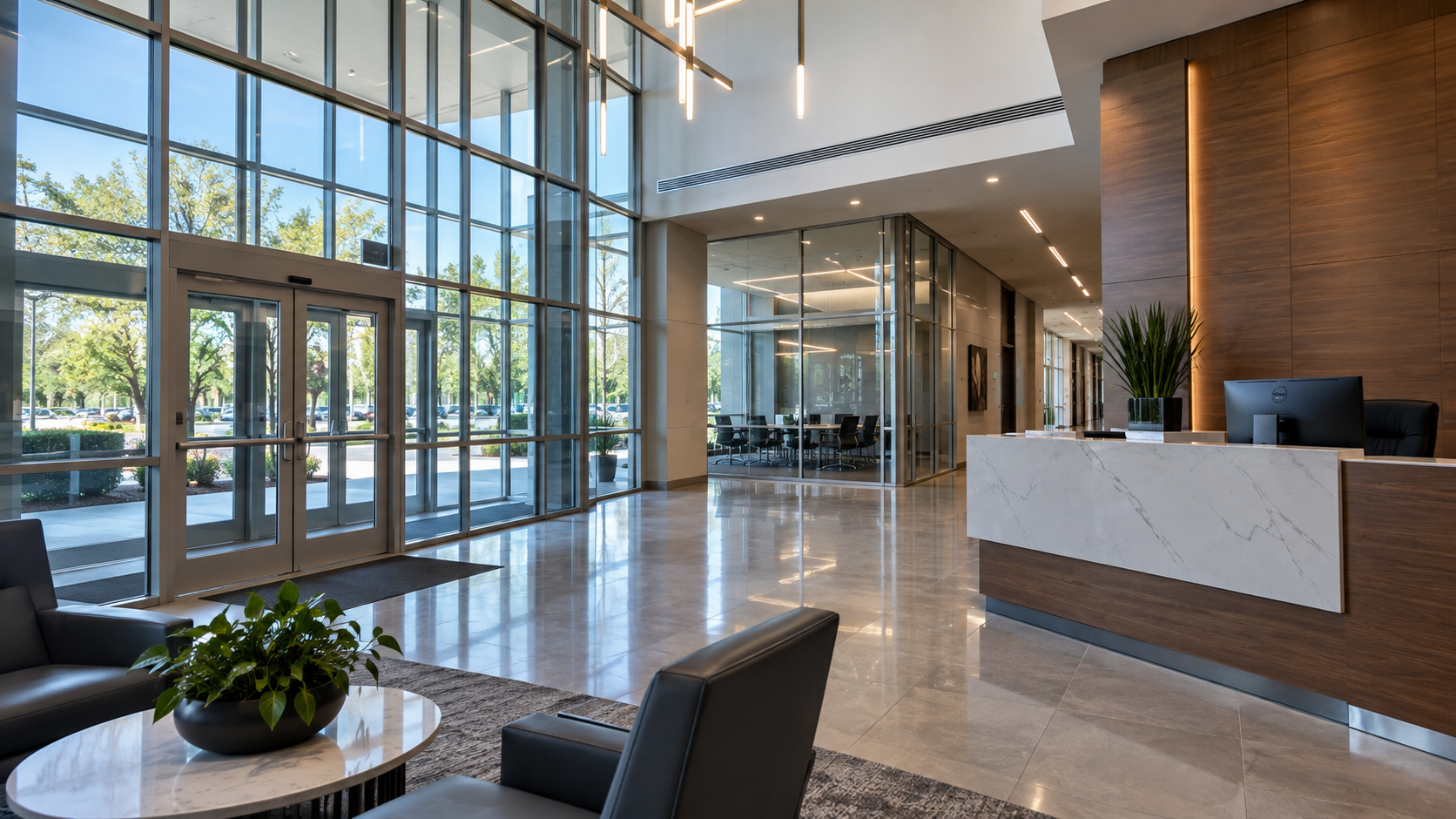
Every workplace is different. An effective physical security assessment evaluates how people enter, move through and use a facility—along with access control, glazing, reception areas, interior circulation and existing protection—before determining where security improvements should be prioritized.
Every workplace has security measures.
Doors lock. Cameras monitor activity. Employees use access credentials. Visitors check in. Alarms, policies and emergency procedures provide additional layers of protection.
But an important question remains:
Do those individual measures work together to address the facility's most significant vulnerabilities?
That is where a workplace security assessment becomes valuable.
An effective physical security assessment looks beyond individual products and evaluates how people, architecture, access, operations and existing security measures interact across an entire facility.
The objective is not to make every office building impenetrable.
It is not to install the most security equipment possible.
And it is not to assume that every organization faces the same risks.
The objective is to understand where people and critical operations are most exposed, identify meaningful vulnerabilities, and prioritize improvements that reduce risk without unnecessarily disrupting the workplace.
For one organization, the highest priority may be access control at a primary entrance. Another may need better visitor-management procedures. Another may discover weaknesses around a reception area, exterior glazing or interior circulation. Other facilities may need improved communications, surveillance, emergency planning or employee training.
And in certain environments, an assessment may determine that physical barriers or ballistic protection should be considered as one component of a broader security strategy.
There is no universal answer.
Good security begins with understanding the environment before selecting the solution.
What Is a Workplace Security Assessment?
A workplace security assessment is a systematic evaluation of a facility's security risks, vulnerabilities, existing safeguards and operational practices.
Rather than examining security as a collection of independent products, an assessment considers how the facility functions as a whole.
That may include evaluating:
Building entrances and exits
Exterior doors and glazing
Parking and pedestrian approaches
Reception and lobby areas
Visitor-management procedures
Access-control systems
Employee-only areas
Interior doors and circulation
Conference and collaboration spaces
Executive and administrative areas
High-occupancy workspaces
Loading and delivery areas
Surveillance and monitoring
Emergency communications
Emergency procedures
Existing physical barriers
Areas used for shelter or protection
The assessment should also consider how employees, visitors, contractors, vendors and the public actually move through the building.
A floor plan may show where a door is located.
An assessment asks what happens at that door throughout the day.
Who enters there?
Is access controlled?
Can employees see who is approaching?
Where does a visitor go after entering?
What separates public areas from employee-only spaces?
What happens if an unauthorized individual moves beyond the lobby?
Those operational questions are often just as important as the physical construction itself.
Security Should Follow Exposure
One of the most useful principles when evaluating workplace security is simple:
Security should follow exposure.
Not every part of a facility faces the same risk.
A public-facing reception desk is different from an employee workspace behind controlled access.
A ground-floor glass entrance is different from an interior conference room.
A loading area has different vulnerabilities than an executive office.
A municipal customer-service counter functions differently from a private corporate lobby.
Understanding these differences allows organizations to concentrate resources where security improvements can have the greatest impact.
Instead of beginning with:
“What security products should we buy?”
begin with:
“Where are our people, operations and critical spaces most exposed?”
That change in perspective can lead to much better security decisions.
Eight Factors to Evaluate When Prioritizing Workplace Security
A useful workplace security assessment should do more than identify a list of deficiencies.
It should help decision-makers understand which vulnerabilities deserve attention first.
The following framework can help organizations evaluate competing security priorities.
1. Risk
What threats are reasonably relevant to the organization, facility, employees or operations?
Risk should be evaluated in context.
A corporate headquarters, manufacturing facility, municipal office, healthcare administrative building and public-facing service center may have very different threat profiles.
Security planning should reflect the actual environment rather than generic assumptions.
2. Exposure
Where are employees, visitors or members of the public most exposed?
Consider locations where people work in close proximity to uncontrolled or partially controlled areas.
Reception desks are a common example.
Employees working at reception may spend much of their day only a short distance from the primary public entrance.
Other examples might include customer-service counters, security desks, conference areas adjacent to public spaces or workstations near exterior glazing.
3. Access
Where can someone enter the facility, and what happens after entry?
An organization may have excellent access control at employee entrances while allowing visitors to enter a lobby with little separation from occupied work areas.
Evaluate:
Primary entrances
Secondary entrances
Employee entrances
Loading areas
Delivery points
Parking-garage access
Interior controlled doors
Stairwells and elevators
Connections between public and private areas
The objective is to understand the path of access, not merely count the doors.
4. Occupancy
Where are people concentrated throughout the day?
Conference rooms, training areas, cafeterias, open offices, lobbies and collaboration spaces may contain significantly more people at certain times than others.
Occupancy can also change throughout the day.
An entrance may be heavily occupied during morning arrival but relatively quiet later.
A conference center may be empty most days but hold hundreds of people during an event.
Security planning should reflect how spaces are actually used.
5. Existing Protection
What safeguards already exist?
This may include:
Access control
Security personnel
Cameras
Intrusion detection
Visitor-management systems
Security glazing
Physical barriers
Interior locking systems
Emergency communications
Policies and procedures
Employee training
The purpose of an assessment is not to replace everything already installed.
Often, the better strategy is to determine where existing layers work well and where meaningful gaps remain.
6. Consequence
What could happen if a particular vulnerability were exploited?
Two vulnerabilities may appear similar but have very different potential consequences.
An uncontrolled door leading into an unoccupied storage area is not necessarily equivalent to an uncontrolled door providing immediate access to a densely occupied workspace.
Evaluating consequence helps organizations distinguish between deficiencies that are inconvenient and vulnerabilities that could have significant effects on people or operations.
7. Correctability
How effectively can the vulnerability be reduced?
Some security deficiencies may be corrected through relatively simple operational changes.
Others may require changes to access control, architecture, physical barriers or building systems.
Organizations should consider whether a proposed improvement actually reduces the identified risk rather than simply adding another visible security feature.
8. Integration
How will the improvement affect the rest of the workplace?
Security does not operate independently from architecture or operations.
A proposed improvement may affect:
Employee circulation
Accessibility
Emergency egress
Visitor experience
Natural light
Visibility
Communication
Building aesthetics
Fire and life-safety requirements
Daily workflows
The strongest security improvement is not necessarily the most visible or restrictive one.
It is the improvement that meaningfully reduces risk while integrating appropriately into the environment.
Evaluate the Workplace in Layers
A workplace should rarely be evaluated as one large space.
It is more useful to examine the facility as a series of interconnected security layers.
A typical sequence might look like:
Property → Building Entrance → Lobby → Reception → Access Control → Interior Circulation → Employee Workspaces → Critical Areas
Each layer creates an opportunity to detect, delay, control or respond to unauthorized access.
The specific layers will vary by facility, but the methodology remains useful across many workplace environments.
Layer 1: Property and Building Approach
Security begins before someone reaches the front door.
Organizations should understand how employees, visitors, vendors and vehicles approach the facility.
Questions may include:
Are primary pedestrian approaches visible?
Are exterior areas adequately illuminated?
Where do visitors park?
Are delivery and service areas separated from primary employee or visitor entrances?
Are secondary entrances controlled?
Are there areas around the building that reduce visibility?
How do employees enter after hours?
The purpose is not necessarily to create a hardened perimeter.
It is to understand how people reach the building and where uncontrolled access begins.
Layer 2: Entrances and Exterior Glazing
Primary entrances deserve careful evaluation because they represent the transition between the public exterior and the controlled interior of the workplace.
An assessment should consider more than whether the doors lock.
Evaluate:
Door construction
Glazing
Sidelites and adjacent windows
Door and window frames
Access-control hardware
Intercoms
Cameras
Visibility from reception
Visitor entry procedures
After-hours access
Secondary entrance points
Large architectural glazing is common in modern corporate facilities because it provides natural light, visibility and an open appearance.
Those architectural benefits do not automatically make glazing inappropriate.
Instead, the assessment should determine whether particular openings create exposure that warrants additional attention.
The security objective should determine the treatment—not the presence of glass alone.
Layer 3: Lobby and Reception Areas
Reception areas occupy a unique position in workplace security.
They are intentionally accessible.
Employees working there may interact with unfamiliar visitors throughout the day, while occupied offices or common areas may be located immediately behind them.
Questions to consider include:
Can reception staff observe people approaching the entrance?
Where are visitors directed after entering?
Is there physical separation between public and employee-only areas?
Can someone move past reception without authorization?
Are employees positioned directly in line with exterior doors or glazing?
Is there a secondary protected location available to reception personnel?
How quickly can staff communicate a security concern?
The objective is not necessarily to build a barrier around the receptionist.
It is to understand how the reception area manages the transition from public access to controlled space.
Layer 4: Access Control and Visitor Management
Technology can play an important role in workplace security, but technology should support a clearly defined process.
An access-control system may regulate employee entry, while visitor-management procedures determine how people without credentials are handled.
Organizations should evaluate:
Who receives credentials?
Which doors are controlled?
How are lost credentials handled?
How are visitors identified?
Are visitors escorted?
How are contractors and vendors managed?
Can doors be remotely controlled?
What happens during an emergency?
Are access permissions reviewed when employees change roles or leave the organization?
A sophisticated access-control system cannot compensate for a process that routinely allows unauthorized people around it.
Physical security and operational discipline need to support each other.
Layer 5: Interior Circulation
Once someone enters a facility, where can they go?
This question is frequently overlooked.
Many modern workplaces emphasize openness and collaboration. Hallways connect departments, glass partitions preserve sightlines and shared spaces encourage interaction.
Those characteristics can be valuable to the workplace experience.
A security assessment should simply understand how those spaces affect movement.
Consider:
Which areas are publicly accessible?
Where does controlled access begin?
Can visitors reach employee workspaces without authorization?
Do stairwells or elevators bypass reception?
Are there alternate routes into critical areas?
Are sensitive operations separated from common spaces?
The objective is not to eliminate openness.
It is to make openness intentional rather than uncontrolled.
Layer 6: Employee Workspaces and High-Occupancy Areas
Security assessments should evaluate where people spend their time—not only where people enter.
Open offices, conference rooms, training rooms, cafeterias, collaboration spaces and other high-occupancy areas may deserve attention depending on their location and exposure.
Questions might include:
How close is the space to uncontrolled access?
What separates it from public areas?
Are employees visible from exterior or public spaces?
Are there multiple routes of movement or egress?
What communication systems are available?
What existing physical protection is nearby?
The goal is not to install barriers throughout every office.
It is to understand where occupancy and exposure intersect.
That intersection can be an important factor when prioritizing improvements.
Not Every Vulnerability Requires Ballistic Protection
This may be one of the most important conclusions of a workplace security assessment.
Not every security vulnerability requires a ballistic solution.
An assessment might determine that the most meaningful improvement is:
Better access control
Improved visitor-management procedures
Additional lighting
Repositioned cameras
Improved sightlines
Door or hardware improvements
Better employee communication
Emergency notification systems
Updated policies
Employee training
Improved coordination with first responders
Physical barriers are one tool within a much larger security strategy.
Installing ballistic protection where it does not address an identified vulnerability can consume resources without meaningfully improving overall security.
Conversely, there are environments where an assessment may identify exposure that warrants consideration of additional physical protection.
The distinction should come from the assessment, not from a predetermined product recommendation.
When Physical Barriers May Become Part of the Strategy
When an assessment identifies a vulnerability where additional physical protection may meaningfully reduce risk, organizations can evaluate the type of protection appropriate to that specific environment.
Different applications may call for different approaches.
Architectural Ballistic Protection
Entrances, exterior glazing, lobbies, reception areas, transaction windows and other critical openings may warrant evaluation for permanent architectural protection.
Purpose-built Ballistic Glass Systems can be designed around specific openings and protection requirements when ballistic glazing is appropriate to the security strategy.
But the same principle we apply to school entrances also applies to corporate facilities:
Ballistic glazing should be evaluated as part of a system.
The glazing, framing, anchorage, surrounding construction, doors and intended threat level can all influence the appropriate design.
Fixed Interior Protection
Some vulnerabilities exist inside the building rather than at the exterior envelope.
Reception areas, administrative spaces, interior partitions and other identified locations may benefit from fixed physical protection when the assessment supports it.
Ballistic wall systems can provide protection while being incorporated into functional interior surfaces.
For example, Titan WallShield™ combines fixed ballistic protection with a dry-erase surface, allowing a security element to remain useful during everyday operations.
The important question remains:
Does fixed protection address the vulnerability identified in this particular location?
Accessible Mobile Protection
Other environments may benefit from protection that is not permanently tied to a wall or architectural opening.
Conference rooms, collaboration spaces, executive areas, reception areas or other occupied locations may have changing layouts and uses.
In appropriate applications, accessible mobile protection can provide another layer without permanently altering the architecture.
The TAG Mobile™ is an example of this dual-use approach: a mobile whiteboard and collaboration surface during normal operations that also provides immediately accessible ballistic protection when needed.
Again, it should not be placed everywhere simply because it can be.
Placement should follow the assessment.
Fixed, Architectural or Mobile Protection?
Organizations sometimes begin by comparing products:
Ballistic glass or wall panels?
Fixed protection or mobile protection?
That may be the wrong starting point.
Each approach addresses a different type of exposure.
Architectural protection can strengthen specific openings or portions of the building envelope.
Fixed interior protection can reinforce identified walls, partitions or protected locations.
Mobile protection can provide accessible protection within occupied spaces where flexibility has value.
In some facilities, only one approach may be appropriate.
In others, several may work together as part of a layered strategy.
And in many workplaces, the assessment may determine that other security improvements should come first.
There is no universal product hierarchy because there is no universal workplace.
Prioritize Improvements Instead of Trying to Fix Everything at Once
A comprehensive assessment may identify more potential improvements than an organization can reasonably implement at one time.
That is normal.
The next step is prioritization.
A practical approach is to separate findings into three general groups.
Immediate Corrections
These may include obvious deficiencies that can be addressed relatively quickly, such as:
Doors that do not reliably secure
Outdated access permissions
Poorly defined visitor procedures
Obstructed cameras
Inadequate lighting
Communication gaps
Unsecured secondary entrances
Correcting fundamental security deficiencies often provides significant value before larger capital projects begin.
Near-Term Security Improvements
These may require additional planning, procurement or coordination.
Examples could include:
Access-control improvements
Visitor-management upgrades
Camera repositioning or expansion
Reception reconfiguration
Interior separation between public and employee spaces
Door or glazing improvements
Emergency communication enhancements
Long-Term Capital Projects
Some vulnerabilities may require architectural or structural changes that should be incorporated into longer-term facility planning.
Depending on the assessment, these could include:
Entrance reconstruction
Lobby redesign
Custom ballistic glazing and framing systems
Secured reception areas
Fixed ballistic wall systems
Renovation of high-risk interior spaces
The fact that a project is expensive or complex does not automatically make it more important.
Likewise, an inexpensive improvement should not automatically receive priority simply because it is easy.
Priority should reflect risk reduction—not project size.
Security Should Support the Workplace, Not Overpower It
A secure workplace does not have to look like a bunker.
This is particularly important in corporate environments.
Architecture communicates something about an organization.
Natural light, transparency, open spaces and inviting reception areas can contribute to employee experience, collaboration and a company's identity.
Security improvements should respect those objectives whenever possible.
That may mean integrating protection into:
Architectural glazing
Reception counters
Interior walls
Collaboration surfaces
Existing design elements
rather than relying exclusively on visibly tactical solutions.
The best physical security is often the protection employees and visitors barely notice during an ordinary day.
That philosophy is central to discreet security design.
A workplace can be welcoming and professional while still incorporating meaningful layers of protection.
Security Is More Than Hardware
Physical security measures are important, but hardware alone cannot create a secure workplace.
Employees are part of the security environment.
Organizations should consider whether staff understand:
How to report suspicious behavior
How visitor procedures work
What to do when a door is propped open
How emergency notifications are delivered
Where to go during different types of emergencies
How to contact security or emergency personnel
What their responsibilities are during an incident
Policies should be understandable.
Procedures should be practical.
Training should reflect the actual facility.
And security improvements should be incorporated into those procedures rather than installed and forgotten.
A layered security strategy combines people, procedures, technology and physical protection.
No single layer should be expected to do everything.
Workplace Security Is an Ongoing Process
A security assessment should not be treated as a one-time event.
Workplaces change.
Organizations grow.
Departments relocate.
New employees arrive.
Reception areas are renovated.
Access-control systems are replaced.
New entrances are created.
Furniture changes circulation patterns.
Threats and operating conditions evolve.
A facility that was appropriately configured five years ago may function very differently today.
That is why security planning should follow a continuous cycle:
Assess → Prioritize → Improve → Train → Reassess
Major renovations, acquisitions, organizational changes or security incidents may also justify additional review.
The goal is not to chase every new security technology.
It is to make sure the security strategy continues to reflect how the organization actually operates.
Questions Organizations Should Ask During a Workplace Security Assessment
A strong assessment should leave leadership with better questions—not simply a longer shopping list.
Consider asking:
Where can the public enter our facility?
Where does controlled access actually begin?
Which employees routinely work closest to uncontrolled areas?
Where are employees or visitors concentrated?
Can someone move from a public area into employee space without authorization?
Which doors, windows or openings create meaningful exposure?
What security measures are already working effectively?
Where do our existing layers have gaps?
Which vulnerabilities could have the greatest consequences?
Which improvements would meaningfully reduce those risks?
How will proposed changes affect everyday operations, accessibility and emergency egress?
Are we selecting solutions because they address an identified vulnerability—or simply because they are available?
That final question is particularly important.
Frequently Asked Questions About Workplace Security Assessments
What is the purpose of a workplace security assessment?
A workplace security assessment helps an organization identify physical and operational vulnerabilities, evaluate existing safeguards and prioritize improvements based on risk, exposure and potential consequence.
The objective is to create a more informed security strategy—not simply identify products to purchase.
What areas should be included in a physical security assessment?
The scope depends on the facility, but assessments commonly consider building approaches, entrances, exits, glazing, reception areas, access control, visitor management, interior circulation, employee workspaces, high-occupancy areas, surveillance, communications and existing physical protection.
How often should a workplace security assessment be conducted?
There is no single schedule appropriate for every organization.
Facilities should be reassessed periodically and when meaningful changes occur, such as renovations, changes in occupancy, new access patterns, organizational growth, security incidents or significant changes to operations.
Does every workplace need ballistic protection?
No.
Ballistic protection should be considered when the organization's assessment, risk profile and security objectives support it.
Other facilities may receive greater benefit from improvements to access control, visitor management, surveillance, communications, procedures, training or other security layers.
Where might ballistic protection be considered in a corporate facility?
Depending on the assessment, potential applications might include entrances, glazing, lobbies, reception areas, public-facing counters, administrative spaces or other identified areas of exposure.
The appropriate location and type of protection should be determined by the specific facility and security objectives.
Is ballistic glass enough to secure a building entrance?
Ballistic glazing is one component of a larger system.
When ballistic protection is appropriate, framing, anchorage, doors, surrounding construction and other components should also be evaluated in relation to the intended protection requirements.
Can workplace security improvements be discreet?
Yes.
Many physical security improvements can be integrated into architectural and functional elements of a workplace. The objective should be to improve protection while preserving normal operations, accessibility, visibility and the character of the environment whenever possible.
From Security Findings to Smarter Investments
A workplace security assessment should not end with a list of everything that could possibly be improved.
It should provide leadership with a clearer understanding of:
where the organization is exposed, which vulnerabilities matter most, what existing protections are already effective, and where additional investment can meaningfully reduce risk.
For some organizations, the next investment may be procedural.
For others, it may involve access control, communications or surveillance.
And where the assessment identifies a need for additional physical protection, architectural, fixed or mobile ballistic systems may become part of a broader layered strategy.
The solution should always follow the problem.
Assess first. Prioritize second. Invest intentionally. Reassess over time.
That is how organizations move from simply having security measures to developing a coordinated security strategy.
Planning Physical Security Improvements for Your Workplace?
Titan Armored works with businesses, corporate facilities, architects, security professionals and other organizations to develop discreet physical protection solutions that integrate into everyday environments.
Our approach is not based on forcing every facility into the same security solution.
Where ballistic protection is appropriate, Titan Armored offers custom Ballistic Glass Systems, Titan WallShield™, TAG Mobile™ and other ballistic security solutions designed around the needs of the facility.
Discuss Your Workplace Security Project With Titan Armored →