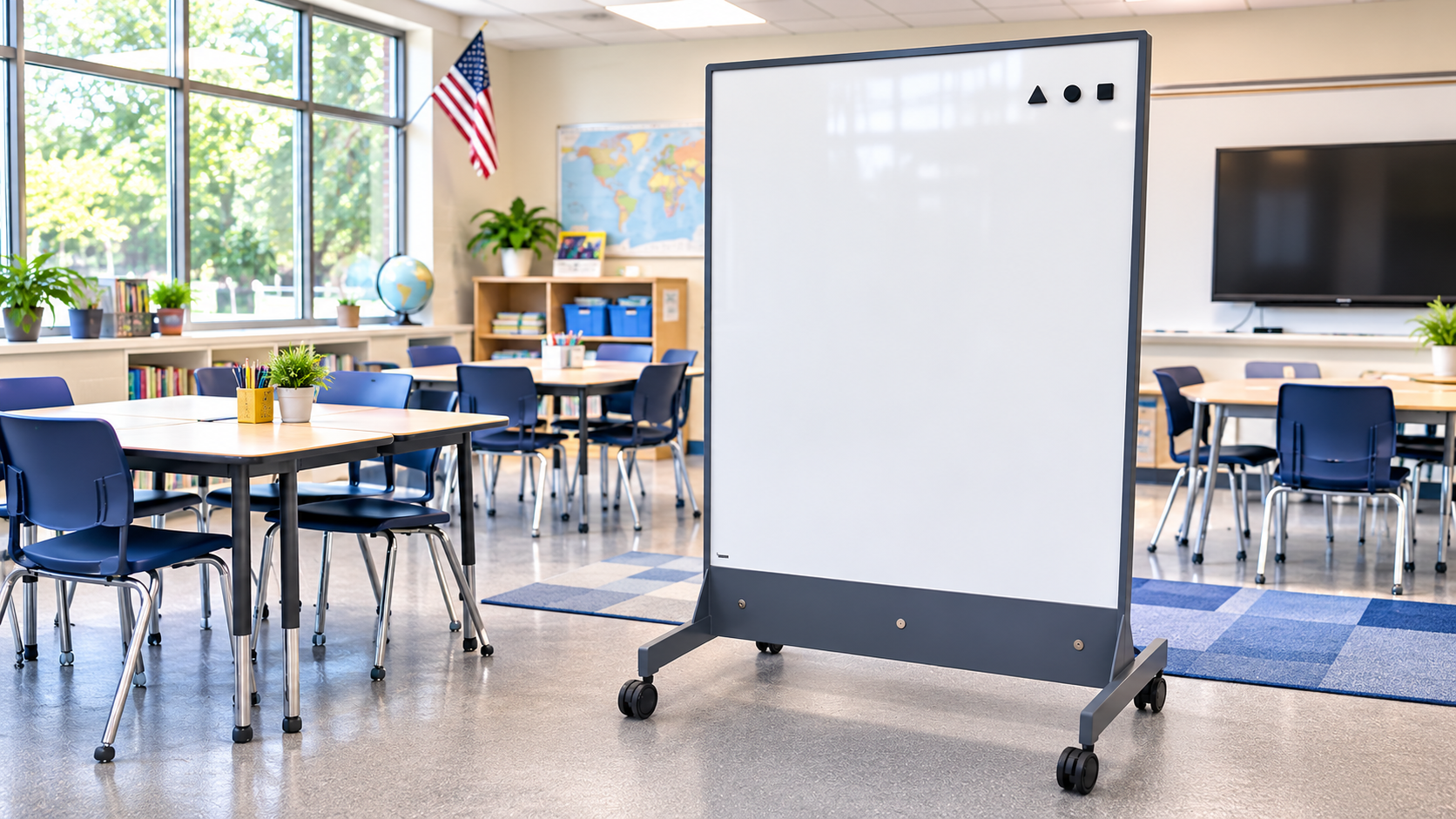
Classroom safety and learning can work together. Titan Armored's TAG Mobile™ combines an everyday magnetic dry-erase whiteboard with tested ballistic-resistant protection.
What if a classroom security solution could support teaching and learning every day while also providing an additional layer of ballistic protection when needed?
For schools evaluating classroom security improvements, this question deserves serious consideration.
Traditional security investments often focus on entrances, doors, locks, cameras, and access-control systems. These measures remain important. But inside the classroom, educators also need spaces that support instruction, collaboration, movement, and a positive learning experience.
Bulletproof whiteboards—more accurately described as bullet-resistant whiteboards—offer a different approach to classroom protection by combining an everyday teaching surface with a mobile ballistic barrier.
Rather than introducing a security product that serves only one purpose, a dual-use ballistic whiteboard can become part of the classroom's daily activities while providing a protective capability that traditional whiteboards do not offer.
Recent research and guidance from the American Institute of Architects reinforce the importance of considering school safety alongside student well-being and the quality of the learning environment.
For public schools, private schools, and faith-based educational facilities, this creates an opportunity to think differently about how classroom protection is selected, designed, and integrated.
School Safety Should Support Learning, Not Compete With It
In October 2026, the American Institute of Architects (AIA) released Let Kids Be Kids: A Progress Report on Schools and Safety, a resource examining the relationship between school design, safety, belonging, well-being, and student success.
Developed through the AIA's Committee on Architecture for Education research initiatives, the report encourages a more holistic approach to educational environments.
Its central perspective is important: schools should be designed as places where children feel safe, welcomed, supported, and able to learn.
Physical security is part of that responsibility, but it should not be considered in isolation from the everyday experiences of students and educators.
For school leaders, this raises several practical questions:
Can security improvements be integrated without unnecessarily changing the classroom environment?
Can protective equipment serve a useful purpose during normal instruction?
Can schools strengthen physical protection while preserving flexibility, collaboration, and accessibility?
How can security investments support the long-term needs of educators and students?
These questions are particularly relevant when evaluating classroom-level protection.
A school may invest in stronger doors, protective glazing, and secured entrances while also considering how to provide additional protective options within classrooms and other occupied spaces.
The challenge is to make these improvements work together.
The AIA report does not evaluate or endorse any particular ballistic whiteboard product. However, its emphasis on learning-centered design provides a useful framework for evaluating dual-purpose classroom protection.
Explore the AIA's Let Kids Be Kids: A Progress Report on Schools and Safety.
What Is a Bulletproof Whiteboard?
A bulletproof whiteboard is a protective panel designed to function as a writing surface while incorporating materials intended to resist specified ballistic threats.
Although bulletproof whiteboard is a commonly used search term, bullet-resistant whiteboard is the more technically accurate description.
No ballistic product should be assumed to provide protection against every firearm, ammunition type, or attack condition.
The actual level of protection depends on the product's construction, tested configuration, and documented ballistic performance.
Some ballistic whiteboards are fixed to walls or other structures. Others are designed as mobile units that can be positioned within classrooms, offices, libraries, or shared spaces.
A mobile ballistic whiteboard may combine:
A functional dry-erase writing surface.
Ballistic-resistant protective materials.
A supporting frame and structural components.
Casters for movement and repositioning.
Locking mechanisms to secure the unit during normal use.
Additional features designed to support classroom functionality.
The defining advantage of a dual-use product is that it can contribute to everyday instruction rather than remain unused as dedicated emergency equipment.
For a more detailed introduction, read our guide: What Is a Bulletproof Whiteboard? The Complete Guide for Schools, Businesses, and Government Facilities.
Why Dual-Purpose Classroom Protection Matters
Every classroom has a primary purpose: education.
Teachers need surfaces for writing, presenting, explaining concepts, and engaging students. Classrooms also need flexible layouts that accommodate different teaching methods, group activities, and learning needs.
A mobile whiteboard can support those activities by allowing educators to reposition the writing surface throughout the room.
When that same product incorporates documented ballistic resistance, it introduces an additional protective capability without requiring a separate piece of equipment to occupy the space.
This is the principle behind dual-purpose classroom protection.
Everyday Functionality
A ballistic whiteboard should first perform its intended educational function effectively.
Writing quality, surface durability, stability, and classroom usability all matter.
A protective product that is difficult to use during normal instruction may be less likely to become a natural part of the learning environment.
Flexibility Within the Classroom
Mobile classroom furniture allows educators to adjust room layouts for lectures, small-group instruction, presentations, and collaborative learning.
A mobile ballistic whiteboard can contribute to that flexibility when its size, weight, movement characteristics, and intended placement are appropriate for the room.
Discreet Integration
Security equipment does not always need to dominate the appearance of a classroom.
A thoughtfully designed ballistic whiteboard can resemble familiar educational furniture while incorporating protective materials within its construction.
This approach aligns with the broader idea that school security should support the learning environment rather than unnecessarily transform it.
For a related discussion, see How to Harden a School Without Making It Feel Like a Fortress.
Introducing TAG Mobile™: A Bullet-Resistant Whiteboard Designed for Everyday Classrooms
Titan Armored developed TAG Mobile™ around a straightforward concept: provide schools with a functional mobile whiteboard that also offers accessible ballistic-resistant protection.
TAG Mobile is a dual-purpose mobile dry-erase whiteboard and protective barrier designed for educational and other occupied environments.
Its design incorporates a magnetic dry-erase writing surface, a gray tackable PET acoustic rear panel, a powder-coated aluminum frame, and heavy-duty locking casters.
The result is a product intended to serve a useful role during normal classroom activities while providing a separately documented protective capability.
Unlike permanently installed wall protection, TAG Mobile does not require permanent installation to function as a mobile unit.
That can be particularly relevant for existing schools evaluating classroom improvements without major renovations.
Designed for the Learning Environment
TAG Mobile's writing surface supports ordinary classroom instruction.
Its rear acoustic panel offers an additional functional surface, and its mobile configuration allows the unit to be positioned according to the room's operational needs.
The objective is to integrate protective capability into a recognizable classroom product rather than introduce an entirely separate architectural element.
Tested Ballistic Performance
TAG Mobile has undergone NIJ Level III ballistic testing.
As with any ballistic protection product, schools should review the actual testing documentation, specified threats, and tested configuration rather than rely solely on broad marketing descriptions.
A ballistic rating should not be interpreted as a guarantee of protection against every threat or in every possible use condition.
Schools should also understand that a mobile ballistic whiteboard is not a substitute for established emergency procedures, secured doors, access control, or other protective measures.
Explore the TAG Mobile™ Bullet-Resistant Whiteboard.
Download TAG Mobile™ Product Specifications
Evaluating bullet-resistant whiteboards for your school or facility?
Review the TAG Mobile™ product specifications for details on its UL 752 Level 8 and NIJ Level III bullet-resistant core, magnetic dry-erase writing surface, acoustic rear panel, Grab Bar, dimensions, and mobility features.
Download TAG Mobile™ Product Specifications (PDF)
For project-specific pricing, quantities, and delivery requirements, contact Titan Armored to request a quotation.
Why Mobility and Maneuverability Matter in Classroom Ballistic Protection
Mobility is one of the most important considerations when evaluating a bullet-resistant whiteboard.
A protective barrier may incorporate substantial ballistic materials, making its weight and movement characteristics different from those of an ordinary classroom whiteboard.
For this reason, schools should consider how a unit will be moved, positioned, and secured during everyday use.
Relevant factors include the room layout, floor surfaces, doorway clearances, available space, caster performance, and the ability of intended users to maneuver the product.
TAG Mobile's Grab Bar: An Improvement Driven by Feedback
Feedback from educators and school safety professionals helped inform the development of a Grab Bar for TAG Mobile.
The Grab Bar provides a designated point for pushing and maneuvering the unit, supporting more controlled movement.
This is an important example of how product design can evolve through real-world feedback.
For a dual-purpose mobile protective system, accessibility and ease of movement are not secondary considerations. They are part of how the product functions within an active learning environment.
The Grab Bar is now a standard feature on every TAG Mobile™, providing a dedicated point for secure handling and more controlled maneuverability. Developed in response to feedback from educators and school safety professionals, this improvement reflects Titan Armored's commitment to practical, user-focused product design.
Schools should also evaluate how the unit will be positioned during normal use and incorporate any intended emergency use into appropriate staff planning and training.
The best classroom protection strategy is one that accounts for how educators actually use their spaces.
What Should Schools Look for Before Buying a Bulletproof Whiteboard?
Not all ballistic whiteboards are designed for the same applications.
Before purchasing, school districts and private educational institutions should evaluate the complete product, its documented performance, and its compatibility with their facilities.
1. Verified Ballistic Testing
Ask the manufacturer for documentation supporting the advertised protection level.
Confirm which standard was used, what threats were tested, and whether the documentation applies to the product configuration being purchased.
A general statement that a product is bulletproof is not sufficient technical information.
For additional guidance, read UL 752 & NIJ Ballistic Protection Standards Explained.
2. Classroom Functionality
Evaluate whether the product performs effectively as a teaching tool.
Consider the writing surface, dimensions, stability, available working area, and compatibility with classroom activities.
The product should contribute to instruction rather than become an obstacle to it.
3. Mobility and Accessibility
Consider the unit's weight, casters, maneuvering features, and available space.
Schools should determine whether staff can safely move the unit under the intended conditions.
A designated Grab Bar or similar feature may be valuable when comparing mobile systems.
4. Classroom Placement and Operational Planning
Consider where the product will be positioned during normal instruction and how it fits into existing safety procedures.
Avoid obstructing exits, accessible routes, required clearances, or other critical building functions.
Any emergency-use procedures should be developed in coordination with the school's established safety planning.
5. Product Specifications and Documentation
Request current product specifications, testing information, warranty terms, and maintenance guidance.
Schools should also confirm which accessories and features are included in the quoted configuration.
6. Delivery and Installation Requirements
A mobile ballistic whiteboard may not require permanent installation, but delivery logistics still matter.
Confirm shipping arrangements, unloading requirements, building access, door clearances, and placement responsibilities before ordering.
7. Budget and Purchasing Requirements
Determine whether the purchase will use district funds, cooperative purchasing arrangements, private donations, or grant funding.
Request a formal quotation identifying the product configuration, quantity, delivery charges, applicable terms, and expected lead time.
For schools evaluating several units, consistent specifications and procurement documentation can simplify the purchasing process.
How Bulletproof Whiteboards Fit Into a Layered School Security Strategy
A mobile ballistic whiteboard should be viewed as one component of a broader security plan.
Effective school security depends on multiple protective measures working together.
These may include:
Secured exterior doors and functioning classroom locks.
Visitor management and access-control procedures.
Appropriate emergency communication and response planning.
Security assessments and staff training.
Protective glazing and reinforced entrance systems where justified.
Classroom-level protective measures selected according to identified needs.
Recent research from the ALERRT Center at Texas State University reinforces the importance of evaluating locks, glazing, access control, and other physical vulnerabilities as part of comprehensive school security planning.
Our recent article, School Door Security: Why Locked Doors Alone May Not Stop Unauthorized Entry, explores those findings and their implications for school entrance protection.
TAG Mobile is not intended to replace these measures.
Instead, a dual-purpose ballistic whiteboard may provide an additional protective option within the classroom while continuing to serve its everyday educational purpose.
This distinction is essential.
Layered security is about selecting complementary measures—not expecting any single product to solve every vulnerability.
Can Private and Faith-Based Schools Use FEMA Grants for Classroom Security?
Funding is an important consideration for many private schools, religious schools, and faith-based educational facilities evaluating security improvements.
One potential source of support is the Federal Emergency Management Agency's Nonprofit Security Grant Program (NSGP).
The program provides funding opportunities for eligible nonprofit organizations seeking to address identified security risks through approved target-hardening and preparedness activities.
Depending on organizational eligibility and applicable program requirements, certain nonprofit private schools, religious schools, and houses of worship may qualify to participate.
What Types of Security Improvements May Be Funded?
NSGP funding may support specified physical security enhancements, equipment, planning, training, and other authorized activities.
Depending on the applicable award and program guidance, these can include approved security improvements involving building entrances, protective doors or windows, access control, and other eligible measures.
However, the program does not automatically authorize every product marketed for school security.
Can FEMA Grants Pay for Bulletproof Whiteboards?
Possibly, but eligibility must be confirmed for the specific product, project, and grant award.
A nonprofit school's eligibility for NSGP funding does not automatically establish that a mobile ballistic whiteboard qualifies as an allowable expense.
The school or grant recipient should verify:
Whether the organization and facility are eligible.
Whether the proposed purchase is consistent with the approved security project.
Whether the equipment falls within an authorized equipment category.
Whether the grant administrator has approved the proposed expenditure.
Whether additional documentation or authorization is required before purchasing.
This is especially important for mobile protective equipment, which may be treated differently from permanently installed facility improvements.
Schools should work directly with their State Administrative Agency or designated grant administrator before committing grant funds.
How Titan Armored Can Support the Purchasing Process
For schools considering TAG Mobile or other ballistic protection solutions, Titan Armored can provide product specifications, available ballistic testing documentation, and formal quotations to support a purchasing review.
Organizations that have already received grant awards should confirm that the proposed equipment and expenditures match their approved scope before proceeding.
Those preparing future applications should begin with a documented security assessment and the current requirements of the relevant funding program.
For additional information, consult the FEMA Nonprofit Security Grant Program and your state's administering agency.
The objective is to help schools make informed decisions about security improvements while respecting the requirements of the funding they intend to use.
How Can Schools Balance Classroom Security, Student Well-Being, and Budget?
School leaders are responsible for making decisions that affect students, educators, families, and entire communities.
Those decisions must account for educational priorities, physical security, operational needs, and available resources.
The AIA's Let Kids Be Kids report provides an important reminder that the design of learning environments influences more than the physical structure of a school.
Classrooms should remain places where students can focus, participate, collaborate, and grow.
Security investments should support those goals wherever possible.
For schools evaluating classroom ballistic protection, a dual-purpose product offers one way to consider everyday functionality alongside additional protective capability.
That does not mean a ballistic whiteboard is the right solution for every classroom or campus.
It means schools have an opportunity to evaluate protective products according to both their security performance and their contribution to the learning environment.
Frequently Asked Questions About Bulletproof Whiteboards for Schools
What is a bulletproof whiteboard?
A bulletproof whiteboard is a writing surface integrated with materials designed to resist specified ballistic threats. Bullet-resistant whiteboard is the more technically accurate term because performance depends on the product's tested configuration and protection level.
Are bulletproof whiteboards actually bulletproof?
No product should be assumed to stop every firearm or ammunition type. Schools should review the manufacturer's ballistic testing documentation to understand the threats and conditions against which a product has been evaluated.
Can a bullet-resistant whiteboard be used for everyday teaching?
Yes. Dual-purpose products such as TAG Mobile™ are designed to function as classroom writing surfaces while incorporating ballistic-resistant protection.
What is a mobile ballistic whiteboard?
A mobile ballistic whiteboard combines a protective barrier and writing surface in a movable unit, typically supported by a frame and casters. Its intended use and protective performance depend on the specific product.
Does TAG Mobile require permanent installation?
No. TAG Mobile is designed as a mobile unit and does not require permanent installation. Schools should still evaluate delivery, placement, floor conditions, and operating procedures.
Why is the TAG Mobile Grab Bar important?
The Grab Bar is a standard feature on every TAG Mobile™. Developed in response to feedback from educators and school safety professionals, it provides a designated point for secure handling and more controlled maneuverability.
What ballistic protection level does TAG Mobile provide?
TAG Mobile™ incorporates a bullet-resistant core specified for UL 752 Level 8 and NIJ Level III ballistic protection. Schools should request the current testing documentation to verify the applicable threats, tested configuration, and performance characteristics.
Can private schools buy bulletproof whiteboards?
Yes. Private schools can purchase ballistic whiteboards, subject to their own budgets, procurement requirements, facility needs, and applicable policies.
Can FEMA grants be used to purchase bulletproof whiteboards?
Potentially, but product eligibility is not automatic. Schools should confirm the proposed purchase with their grant administrator, including the applicable award conditions, equipment classification, and approved project scope.
Are faith-based schools eligible for FEMA security grants?
Certain eligible nonprofit faith-based schools may qualify for the Nonprofit Security Grant Program, depending on their organizational status, risk assessment, and program requirements. Eligibility and funding are not guaranteed.
How much does a bulletproof whiteboard cost?
Pricing depends on the manufacturer, tested protection level, size, product features, quantity, delivery requirements, and purchasing terms. Schools should request a current quotation for the configuration being evaluated.
Can a mobile ballistic whiteboard replace classroom door security?
No. A mobile ballistic whiteboard should be considered a supplemental protective measure, not a replacement for functioning locks, access control, emergency procedures, or other elements of a comprehensive school security plan.
The Future of Classroom Protection Should Keep Learning at the Center
The conversation around school security continues to evolve.
School leaders are looking beyond individual products and considering how protective measures fit into the buildings, classrooms, and daily routines that define the educational experience.
The American Institute of Architects' recent work reinforces the importance of creating schools where safety, belonging, and learning can coexist.
For classroom protection, this perspective raises a valuable question:
Can the products we introduce to improve security also make a meaningful contribution to everyday learning?
Dual-purpose bullet-resistant whiteboards offer one approach worth evaluating.
By combining familiar classroom functionality with documented ballistic-resistant materials, these products can provide additional protective capability without requiring the learning environment to revolve around security equipment.
At Titan Armored, that philosophy is central to the development of TAG Mobile™.
We believe classroom protection should be practical, accessible, thoughtfully designed, and compatible with the environments where students and educators spend their days.
Because protecting a classroom should never mean losing sight of what the classroom is for.
Explore TAG Mobile™ Bullet-Resistant Whiteboards
Titan Armored is a U.S. manufacturer of discreet ballistic protection solutions for schools, educational facilities, houses of worship, government buildings, and commercial environments.
Our flagship TAG Mobile™ combines a magnetic dry-erase writing surface with mobile ballistic-resistant protection, offering a dual-purpose solution for classrooms and other occupied spaces.
For schools evaluating classroom protection, our team can provide product information, available testing documentation, and project-specific quotations.
Explore TAG Mobile™ Bullet-Resistant Whiteboards
Contact Titan Armored to Request a Quote
Built for learning. Ready when it matters most.
Research and funding resources
American Institute of Architects. (2026). Let Kids Be Kids: A Progress Report on Schools and Safety. Read the AIA report.
Federal Emergency Management Agency. Nonprofit Security Grant Program. Review FEMA program information.
Grant funding and product eligibility vary by award, jurisdiction, and program requirements. Schools should obtain confirmation from their grant administrator before using grant funds for a specific purchase.